The problem with “back when…”
Every so often, I’ll come across postings of photos of a grimy Times Square in the 1970s or burnt-out buildings in Alphabet City in the 1980s. The comments are often predictable: the city had character, it was better then, I felt safer then.
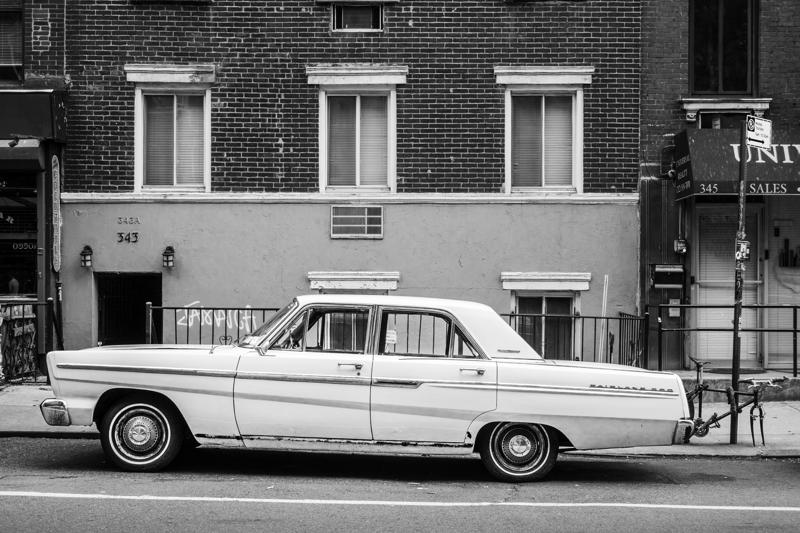
I hear a similar vibe about old cars: we didn’t wear seatbelts, and everyone was fine.
Both sentiments are nonsense, but they’re predictable nonsense. They’re the product of well-documented cognitive biases that distort how we remember the past.
What’s really going on is often less about New York (or cars) and more about memory.
The peak-end rule: memory is a highlight reel
In a December 2025 article on The Philosophical Case for Christmas, Jonny Thomson of Mini Philosophy touched on a phenomenon that Nobel laureate Daniel Kahneman and psychologist Barbara Fredrickson identified in their groundbreaking 1993 research: the peak-end rule.
Their experiments demonstrated that we judge past experiences by their most emotionally intense moment (the peak) and how they ended (the end), not by their average or duration. (SAGE Journals)
Applied to city nostalgia, the “experience” people are judging is often a mashup of:
-
a few peak moments (a wild night out, the first apartment, the first real freedom), and
-
a fuzzy ending (graduation, moving away, “those were the days”).
That highlight reel can feel more vivid than decades of noise, grime, stress, or risk.
Two other memory tricks that fit the pattern
The peak-end rule is part of the story, but it has friends.
Rosy retrospection
People tend to remember past experiences as more positive than they felt in the moment, especially after time passes. Psychologists call that rosy retrospection. (Wikipedia)
The reminiscence bump
Adults also have a well-known tendency to recall a disproportionate number of vivid memories from adolescence and early adulthood. That window often anchors what “real life” felt like. (Wikipedia)
Put those together, and you get a powerful illusion: youth becomes a warm filter you accidentally apply to the whole era.
This explains why the 70-year-old commenting on photos of 1980s New York isn’t really evaluating the city. They’re evaluating their youth. They’re confusing their vibrant memories of being 20 and carefree with the objective quality of the environment they inhabited. The joy of freedom, possibility, and physical vitality gets projected onto the grimy subway and the crime-ridden streets.
Survivorship bias makes nostalgia louder
A final cognitive trap that adds to these effects is survivorship bias.
Survivorship bias is what happens when we mostly see the stories from people who made it through a filter, while the missing stories fade out of view. (Encyclopedia Britannica)
That applies to nostalgia posts:
-
People who had a great time in 1978 will happily post photos and memories.
-
People who were assaulted, traumatized, or pushed out of the city are less likely to show up in your feed as cheerful commenters.
The people posting about how safe they felt in 1970s New York are, by definition, survivors. They walked those streets, and nothing terrible happened to them. The people who were murdered (over 1,600 per year in the mid-1970s, compared to around 400 today) aren’t posting on social media. The robbery victims, the assault victims, the people who left the city in fear have largely moved on. The sample of voices expressing nostalgia is pre-filtered for those who came through unscathed.
Social media then adds its own filter: dramatic photos and romantic captions travel farther than “I spent 1977 anxious and broke, and the subway scared me.”
The classic example of survivorship bias comes from World War II.
Military analysts studied bullet holes on aircraft returning from combat missions and initially proposed armoring the areas that showed the most damage.
Mathematician Abraham Wald pointed out the flaw: they were only examining planes that survived. The holes they could see marked locations where planes could take damage and still return. The fatal hits were invisible; they’d brought down the planes that never came back. The military needed to armor precisely where the returning planes weren’t hit.
The same phenomenon explains the “nobody got hurt” claims about pre-seatbelt driving. Even with astronomically higher fatality rates, most individual drivers didn’t experience serious accidents, and those who died in crashes aren’t available to share their experiences. The survivors assume their luck was universal.

NYC was not safer back then
Let’s set memory aside and look at the data.
New York City’s homicide counts were dramatically higher in that period.
-
1970: 1,117 murders
-
1980: 1,814 murders
-
1990: 2,245 murders (the peak year)
-
2023: 391 murders (Wikipedia)
Even without getting into debates about what caused crime to rise or fall, the direction is clear: the baseline level of lethal violence was much higher then than it is now.
The homicide rate has fallen to less than one-sixth of its peak. Today’s New York has a lower murder rate than the national average and far lower than comparable major cities.
And yet, individuals can still honestly say, “I felt safe.”
That’s because personal safety is probabilistic. Even during high-crime periods, most people won’t be victimized on any given day. It is completely possible to live through a risky era and come away with a memory dominated by your best nights.
… or cleaner
In the 1950s, 1960s, and early 1970s, New York suffered deadly smog events that killed dozens or hundreds of people at a time. The 1966 Thanksgiving smog disaster remains one of the worst air pollution events in American history. Residents recall that you could wipe a windowsill clean in the morning and find it covered in dark grey particulates by evening.
Sulfur dioxide levels peaked around 1964. Particulate matter remained dangerous through the early 1970s. After the Clean Air Act of 1970, pollution dropped dramatically and continued to fall.
Between burning coal (natural gas and oil started replacing coal in the 1960s and coal furnaces were phased out of public schools by 2001), burning garbage (lots of apartments and companies had incinerators, which were shut down by 1993), car pollution (leaded gas was phased out in the 1990s), and industrial pollution, the air was unsafe.
The water was gross
Waterways are another place where nostalgia flips the story. In the summer of 1970, a Hudson River study found so little dissolved oxygen that the few fish seen were at the surface, gulping air. Today, decades of sewage treatment and regulation have significantly improved water quality, and hundreds of fish species, along with oyster beds, have been recorded in the Hudson and its watershed.

I came across this chart that compares the quality of the waters surrounding New York City between 1985 and 2020. Virtually all the water was unsafe and unfit for life back then … and 1985 was 12 years after the Clean Water Act was signed into law and decades after slaughterhouses stopped operating in the city. The water was worse prior to then. Much, much worse.
 I’ve used New York City as an example since that’s where I lived but the same issues existed in other cities, often at an even greater scale. Los Angeles had the highest levels of photochemical smog in the U.S. – a combination of particulate matter, nitrogen oxides, and volatile organic compounds. Waterways were unbelievably filthy as well: New York’s Buffalo River, Michigan’s Rouge River, Ohio’s Cuyahoga River, Pennsylvania’s Schuylkill River, and illinois’ Chicago River have all caught fire, some more than once. The Cuyahoga, for example, caught fire 13 times.
Old cars, seatbelts, and the myth of “we were fine”
The driving version of this story is even more brutal, because the “missing data” is literally missing.
U.S. traffic fatality rates per 100 million vehicle miles traveled were far higher in the 1970s and 1980s than they are today:
-
1970: 4.74
-
1980: 3.35
-
1990: 2.08
-
2023: 1.26
Your chance of dying on any given drive was approximately three times higher in the 1970s than it is today.
So if someone says, “We didn’t wear seatbelts, and nobody got hurt,” what they often mean is: “In my circle, I did not personally see the worst outcomes.” Survivorship bias makes that kind of anecdote feel representative when it is not.
It also blends with the peak-end rule: the remembered driving experience is often the peak of independence. The actual day-to-day tradeoffs (worse crash protection, weaker lighting, less predictable handling, fewer safety features) don’t take center stage in the memory.
Safer cars
Those improvements occurred despite (or because of) all those features that nostalgia-addled drivers mock:
-
Crumple zones absorb impact energy
-
Airbags cushion occupants
-
Anti-lock brakes prevent skids
-
Backup cameras prevent driveway fatalities
-
Power steering lets drivers maneuver in emergencies
-
Automatic Emergency Braking uses cameras and radar to spot potential front-end crashes with vehicles or pedestrians and, if necessary, apply brakes
-
All-wheel drive
-
Brighter lights (old incandescent sealed-beam headlights had a light output of around 300-500 lumens; modern LED headlights output 2,000 to 4,000 lumens)
Those bench seats that people remember fondly? They let unrestrained passengers become projectiles in crashes.
More places this shows up
Once you notice the pattern, you’ll see it everywhere:
“College was better back then”
People remember the peak moments: friends, late nights, a sense of possibility. They forget the baseline: stress, insecurity, bad sleep, and the constant low-level panic about grades and money. That baseline still exists, but there are more resources available for learning, such as tutorials on YouTube, Khan Academy, Generative AI, online lectures. Universities provide more opportunities for counseling and student success. Cafeterias and meal plans have evolved tremendously. So have a lot of the facilities, like common areas, labs, and classrooms.
“Air travel used to be glamorous”
Many people remember one great flight (or, more likely, flights depicted in movies or ads), the clothes, the vibe, the novelty. They forget the routine: smoke-filled cabins, high prices, fewer safety standards, no seatback entertainment, worse accessibility, and a lot less transparency when things went wrong. Moreover, flying before deregulation was seriously expensive and out of reach for most people.
“Kids today are coddled”
This often starts with a true statement: “I survived risky stuff.” It ends with a bad inference: “Therefore it was fine.” Survivorship bias is doing a lot of work in that jump. (Encyclopedia Britannica)
What we choose to remember
Understanding these biases doesn’t eliminate them. Even knowing about rosy retrospection, the reminiscence bump, and survivorship bias, people will still feel a warm glow when they hear songs from their teenage years. That glow is real; it’s the emotional truth of their memory, but it’s not evidence about whether the past was objectively better than today.
The danger comes when we mistake emotional truth for historical truth. When we make policy based on nostalgia rather than data. When we assume that the past provides a template for the future because it feels good to remember it.
When you catch yourself thinking “it was better then,” try three questions:
-
What’s the base rate? Look for numbers, not vibes (crime rates, fatality rates, health outcomes).
-
What are you really missing? The city, or the version of you that lived in it?
-
What stories are you not hearing? Ask who got filtered out: the people who moved away, burned out, got hurt, or never had the money to enjoy the peaks.
Nostalgia is a lovely emotion. It is also a terrible measurement tool.
The past wasn’t better. You were just younger.